Moved

This blog has moved to offthespork.com. Thanks!
Showing posts with label baking: bread. Show all posts

Sunday, June 13, 2010

Cookbook Challenge: Week 30, Baked

Treacle oatmeal loaf


Recipe: Molasses oatmeal loaf
From: Quick Breads


We're on to week 30 of the Cookbook Challenge, and the theme is "baked". Easy right?! For someone who does a lot of baking, this week's theme was great!

I was pretty keen to bake bread of some kind, but I ran out of time to do a proper loaf. Instead, I pulled out a book that has recipes for quick breads, and put together this loaf in just over an hour. It should have taken longer, but I didn't let the oats soak for the full 30 minutes - as soon as my oven had preheated I figured it was good enough.
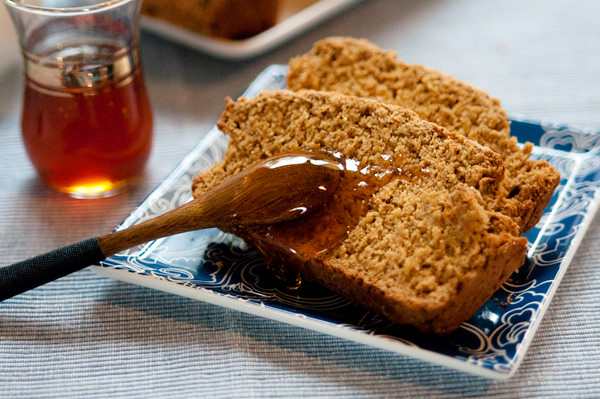
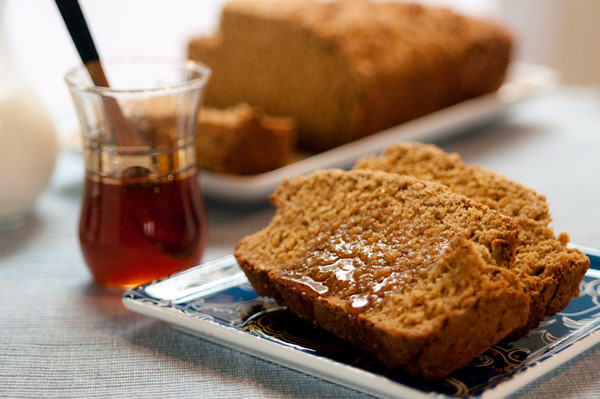
Treacle oatmeal loaf


The loaf is made with porridge oats, molasses or treacle (I used treacle), buttermilk and a mixture of wholemeal and white flour. And it is really good! The oats and wholemeal flour give a chewy, nutty, texture and flavour with a crisp crust. Because it has a mix of white and wholemeal flour, it's not too dense or heavy. When it came out of the oven, I couldn't wait for the loaf to cool completely before I cut a slice to taste. Bad, I know, but who can resist bread straight from the oven? Not me! It was great with butter (natch) and a second slice was also really good with honey. The third slice (ha!) saw the return of butter, but I do think a bit of sweetness works really well with this bread.

I'll definitely make it again. And I'm looking forward to eating the rest for breakfast tomorrow!

See previous Cookbook Challenge posts here.

Update: see the round up for this week at My Food Trail.
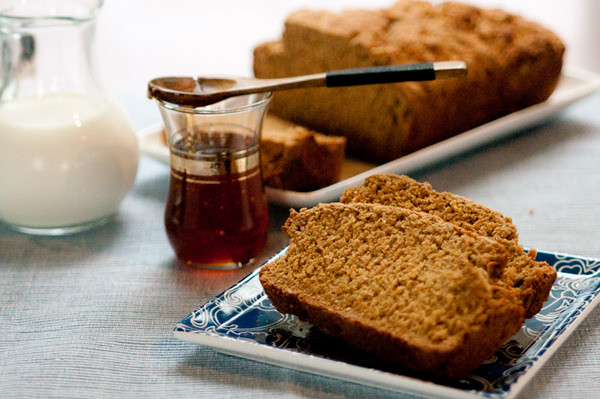
Treacle oatmeal loaf


Molasses oatmeal loaf


From Quick Breads

Makes a medium loaf


2 tablespoons molasses/black treacle
300ml buttermilk
75g porridge oats
200g plain wholemeal flour
200g plain white flour
1 teaspoon bicarbonate of soda
1 teaspoon sea salt
25g unsalted butter, chilled and cut into cubes
1 large egg, beaten

a 450g loaf tin, well greased

Mix the molasses/treacle and buttermilk in a bowl and add the oats. Stir, and let it soak for 30 minutes.

Preheat the oven to 200°C.

In a separate bowl, stir together the flours, bicarbonate of soda and salt. Add the butter and rub it in, using the tips of your fingers until it looks like fine breadcrumbs.

Add the beaten egg and the soaked oats and mix well with a wooden spoon. It will be a very thick, heavy dough. Pour it into the greased tin and press it into a loaf shape.

Bake the loaf for 10 minutes, and then reduce the oven temperature to 180°C. Bake for a further 35 minutes.

Turn out on to a wire rack and let it cool completely before slicing.


Wednesday, October 14, 2009

Bagels

Note: This is a scheduled post - Alastair and I are currently in Hong Kong and will be back home soon. Normal programming will resume shortly!

At my old job, I had a terrible habit of not taking breakfast to work, and buying breakfast at the cafe in our building. I also had a bad habit of taking breakfast into work, not eating it, and buying something instead. Gaaah.

Finally, something clicked, and I realised I was doing this because I didn’t like what I had planned for breakfast! I kept buying bagels for breakfast, and "ding ding" I realised that I could just make my own.

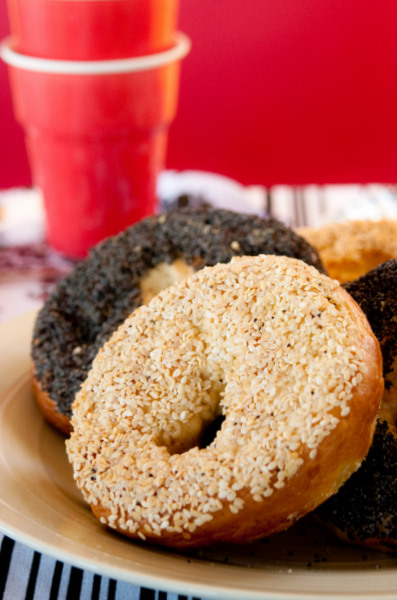
Bagelicious


So I did! And they were awesome. They were very chewy, which I do like, but due to the chewiness I preferred them toasted rather than fresh. I stashed several in the freezer for future breakfasts.

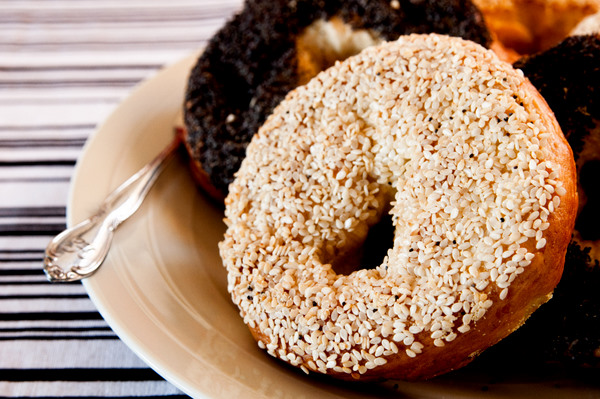
The recipe says that when the bagels are put into the water for boiling, they should sink first and then rise back to the surface. Mine all floated – and rather annoying, there was nothing to indicate how to make them more “bagely” so they would sink. And for some reason, when they came out of the water, they were all lumpy! So not very attractive, but I managed to hide the lumpiness with sesame seeds and poppy seeds.

Bagelicious


Bagels

The recipe is from here. I have rewritten it to make it easier to follow, but I recommend you read it through because it has some useful tips.

6-8 cups bread flour
4 tablespoons instant yeast
6 tablespoons sugar or light honey
2 teaspoons salt
3 cups hot water
Vegetable oil
Water for boiling
3-5 tablespoons malt syrup or sugar
A few handfuls of cornmeal (I used fine polenta)

Pour 3 cups of warm water in a large bowl. Stir in the sugar or honey. Sprinkle the yeast over and stir to dissolve. Set it aside for 10 minutes.

After 10 minutes, the yeast should be nice and foamy (if this doesn’t happen, start again with new yeast!). Add 3 cups of flour as well as the salt to the yeast mixture and start mixing it in. Add more flour, half a cup at a time, mixing each addition thoroughly before adding more. Eventually, it will become a stiff dough (you may not need all the flour).

Turn out on to a clean, dry countertop and knead until it is smooth and elastic. It should be heavy and stiffer than a normal bread dough.

Place the dough in a lightly oiled bowl and cover it with a damp kitchen towel. Leave the bowl in a dry, warm place and leave it to rise until it is doubled in volume (I left mine for a couple of hours).

Preheat the oven to 400 degrees F. When the dough has risen, get the boiling water ready. Get a large pot and fill it with a generous amount of water. Put it on high heat and let the water come to the boil. When it reaches a boil, add the syrup or sugar and turn down the heat so the water barely simmers.

Turn out your dough on to a clean work surface, punch it down, and divide into about 16 even-sized pieces. To form the bagels, shape the dough into a long cylindrical snake shape. Wrap it around a rolling pin, push the two ends together to join, and then roll the bagel up and down the rolling pin to smooth out the sides.

When all the bagels are formed, let them rest for 10 minutes. They will rise slightly, ideally by about 1/4th volume.

One by one, drop the bagels into the pot of simmering water. Only have two or three bagels in the water at a time – and they will puff up so watch out for it. The bagels should sink first and then flat to the top. Let the bagel simmer for three minutes then turn it over and simmer for another three minutes.

Lift the bagel out of the water and set on to a clean kitchen towel. The bagels should be shiny, due to the malt syrup/sugar in the boiling water.

When all the bagels have been boiled, sprinkle baking trays with cornmeal. Arrange the bagels on top, put them in the oven, and bake for about 25 minutes. Turn them over and bake for another 10 minutes. This helps to prevent flat bottomed bagels.

Remove from the oven and let them cool completely on wire racks before slicing.


Friday, June 5, 2009

Soup Sunday: Curried pumpkin and kumara soup + onion focaccia

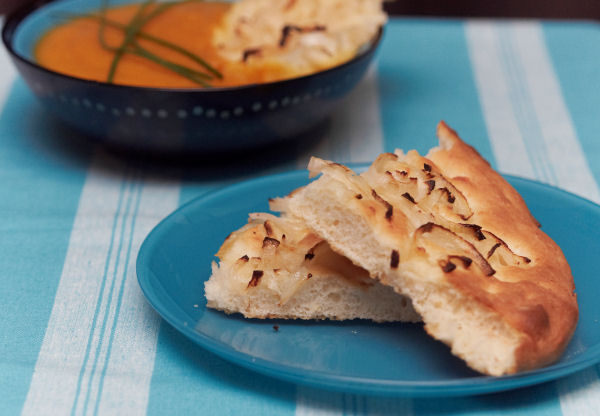
Pumpkin & kumara soup + onion focaccia


Gosh, I'm running a bit late with the Soup Sunday post - it's almost Sunday again! (And I have a super duper long weekend edition planned. Oh my!). The soup for this Sunday helped me use up bits and pieces - one of the reasons I love making soup! I had a few kumara (sweet potatoes), half a pumpkin, a couple of carrots and a leek. Not much by themselves, but all together they were a pot of orange goodness.

Into the pot went the sliced leek, a couple of crushed cloves of garlic, three diced kumara, the diced pumpkin half and two diced carrots. After they softened in a glug of oil for several minutes, I added enough water to just cover the vegetables. I let it simmer until soft, blended it up with the stick blender, and then seasoned with salt and pepper plus a smidge of curry powder (I love curry and pumpkin together).

The end result was pretty much pumpkin soup, but the kumara did add a touch more sweetness than usual.

Pumpkin & kumara soup + onion focaccia


I also made an onion focaccia that evening using a recipe from my baking bible, Australian Women’s Weekly “Bake”. The focaccia was great! I let my mixer do the kneading so all I really had to do was throw the ingredients in the bowl and slice the onions. I'll definitely use this recipe again as a base and try some different variations.

Onion focaccia

From Australia Women's Weekly "Bake"

2 & 1/2 cups (375g) plain flour
2 teaspoons (7g) dried yeast
1/2 cup (20g) finely grated parmesan cheese
2 tablespoons coarsley chopped fresh sage
3 teaspoons sea salt flake
1 cup (250ml) warm water
1/4 cup (60ml) olive oil
1 small white onion (80g) sliced thinly

Sift the flour into a bowl and stir in the yeast, cheese, sage and 1 teaspoon of the salt. Gradually stir in the water and 2 tablespoons of the oil. Knead for about 10 minutes until the oil is smooth and elastic.

Place the dough on an oiled tray and press into a 24cm circle. Cover with oiled plastic wrap and let it stand in a warm place until it doubles in size.

Preheat the oven to 220°C.

Combine the onion, remaining salt and remaining oil in a bowl. After the dough has finished rising, remove the plastic wrap and sprinkle the top with the onion mixture.

Bake for approximately 25 minutes. Let it cool on a wire rack.


Related Posts with Thumbnails